

The Small Dance
Balance and baby steps

From ages 18-22 I attended New York University’s Tisch School of the Arts, where I studied drama at the Experimental Theater Wing (ETW). There are many parallels between postmodern, physical theater and working with young children (listening and responsiveness, improvisation, breaking down hierarchies, rolling around on the floor); I’ve recently found myself thinking about something very specific from my days as a drama student.
While at ETW I was lucky enough to work with Mary Overlie, a true visionary. Mary changed the way I see the world in both profound and subtle ways, and her ability to soften towards and attend to what others might have found small and insignificant is something I return to often.


One day in Mary’s class, she asked us to stand. Picture 15 of us earnest theater students around 20 years old, standing on the hardwood floor of our studio room, one wall all windows out to Broadway, the other with a barre across its length. Mary asked us to close our eyes and stand, with both feet planted on the ground. She asked us to notice all the tiny movements our bodies made to keep us standing. We might look still to an outsider, she said, but that stillness is only possible because our muscles are constantly adjusting to hold us there. She called this “The Small Dance.”
This spring I’ve gotten to witness several children who I’ve known from early infancy as they toddle their way into the next stage of their lives. They lift one foot and make that leap of faith in themselves: taking a step. They wobble on round feet not yet used to the floor beneath them. They rise, meerkat-like, and balance, standing. They haven’t developed our practiced ease or forgotten how much work it is to stand. Even from the outside, I can see every muscle as it tenses and relaxes, all working hard to hold this quite-new person on their feet. I get to witness the Small Dance each of these bodies does, and will continue to do for as long as they stand, although it will become much smaller and more subtle.
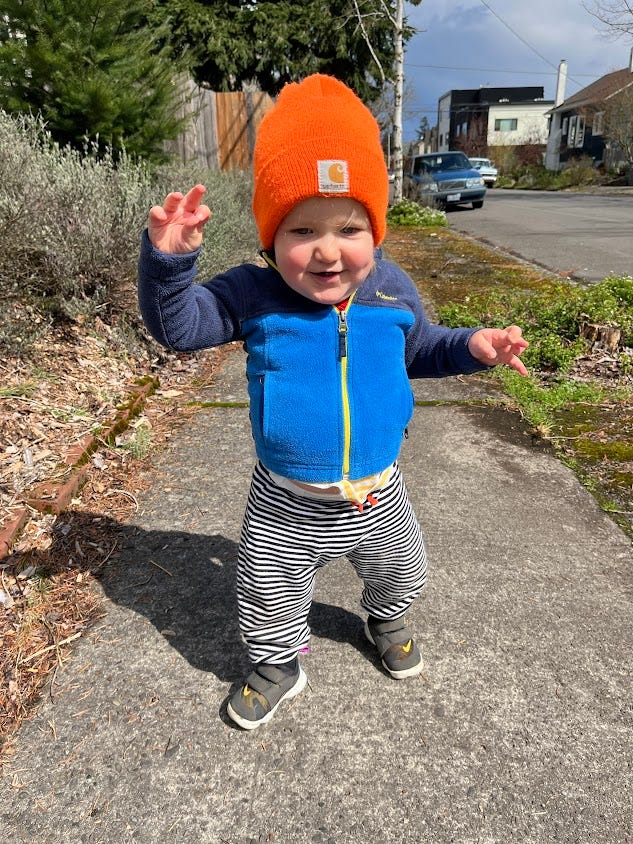
Slowing down enough to notice each tiny movement on its way to the next is something I tried to do as a young theater student living in New York and something I’ve gotten much better at as a parent and playgroup professional. While my route to this work has never been a straight line, it is easy for me to find the threads of connection between then and now, particularly when I think about teachers like Mary Overlie and the way she offered me a different lens through which to view the world.
I find myself returning to that lens often in my work with young children. What looks like stillness from the outside is often a dozen or more internal adjustments working to keep them upright. The Small Dance isn’t something we outgrow, it just becomes harder to see.
Love this reflection. I have been thinking about how much effort it takes to sit up, stand, etc as I witness my second child becoming.